
WriteAnyPapers.com Review: Inside the Writing Process
Perspective note: I teach writing-intensive courses and supervise capstone-style projects. For this review, I treated WriteAnyPapers.com as a system — interfaces, constraints, policies, escalation paths — not as a single “good/bad essay” outcome. The central question is simple: how predictable is the workflow when you change deadlines, academic levels, and task types under pressure?
Pros & Cons
Pros:
- Clearly defined revision and refund policies — structured and rule-based framework.
- Streamlined, parameter-driven order form — fast placement without unnecessary friction.
- Free revisions within the stated window (if aligned with original instructions).
- Strong deadline flexibility — supports urgent orders (as low as 3 hours).
- Transparent distinction between plagiarism checking and paid plagiarism report add-on.
Cons:
- Policies are strict — disputes and refunds require documented proof and adherence to timing rules.
- Low friction increases risk of under-specified instructions, which may affect final outcome.
- Scope changes during revision may trigger additional fees (instruction drift penalty).
The “Academic Pressure” Stress-Test
I ran a stress simulation that mirrors a rough semester week: one urgent submission window, one mid-range deadline, and one planned assignment. The point was not to “catch” the service — rather, to observe how WriteAnyPapers.com behaves when urgency increases, instructions expand, and the revision clock starts ticking.
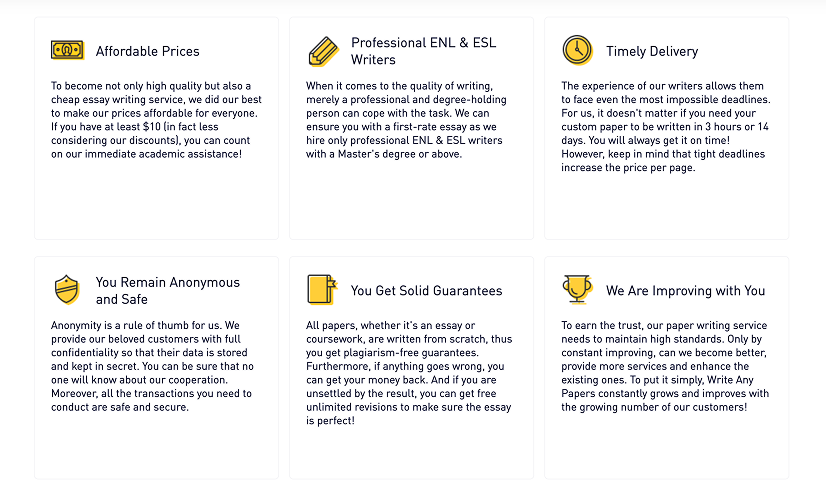
Workflow Map — What I Tested
- Input stage: order form options (paper type, academic level, pages/words, deadline, formatting, sources).
- Pricing stage: how the calculator communicates cost, what is included, what costs extra.
- Execution stage: delivery timing, adherence to constraints, and variance across urgency.
- Post-delivery stage: revision policy mechanics and refund trigger points.
- Transparency stage: how clearly the platform states rules, evidence standards, and time windows.
Order Set — 3 Orders Under Different Pressure
| Order | Deadline | Academic Level | Work Type | What This Order Tests |
| A | 3 hours (panic) | College / undergraduate | Argumentative essay | Urgency behavior, support responsiveness, “good enough” structure under time compression |
| B | 48 hours (mid) | University / upper-level | Literature review (mini) | Source handling, outline discipline, structural coherence |
| C | 7 days (planned) | Master’s | Reflective paper | Nuance, tone control, revision readiness, low-risk predictability |
The Order Form on WriteAnyPapers.com
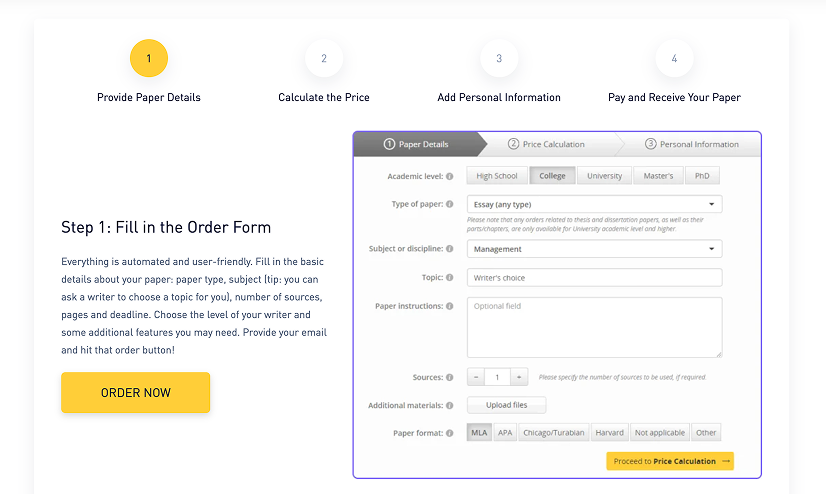
WriteAnyPapers.com positions the ordering flow as “automated and user-friendly,” explicitly noting that you move through “windows” and select parameters rather than writing long briefs. Their “How it Works” page frames this as an anti-friction design: pick subject/format/sources/level, then select deadline and writer preferences, then see price and pay.
Order Form as a System
- Window 1: paper basics (subject, format, number of sources, academic level, instructions upload).
- Window 2: deadline + writer preference logic (ENL vs ESL positioning, “preferred writer” concept).
- Window 3: price confirmation + minimal identity requirement (nickname acceptable, privacy emphasis).
My UX Notes — First-Person, Systems Lens
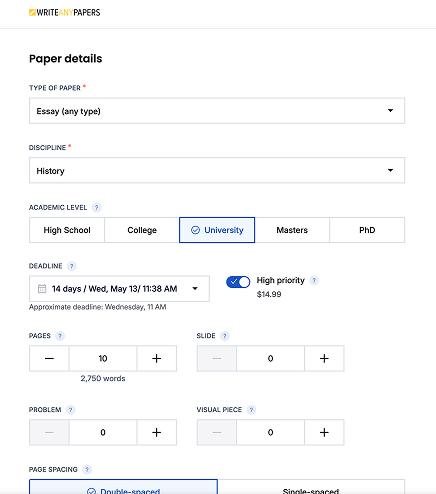
- Strength: the site consistently nudges you toward parameter selection (deadline, level, pages) rather than narrative explanation, which reduces placement friction.
- Risk: that same frictionless design increases the chance of “instruction under-specification.” In my experience, under-specification is the #1 driver of revision disputes and refund denials.
- Practical takeaway: if you want predictable outcomes, your brief must be rigid: thesis, structure map, citation style version, source rules, and “do/don’t” constraints.
What I Could Verify Publicly
Here is what I can verify from publicly visible pages on WriteAnyPapers.com:
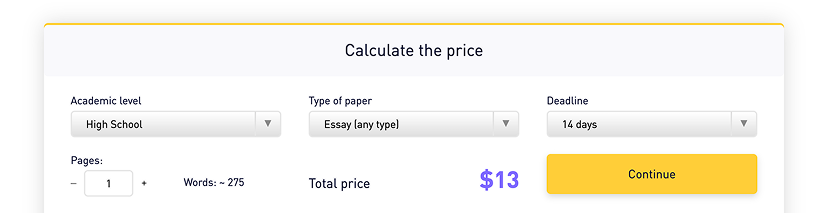
- The Prices page shows a calculator state where Total price = 10 for an essay with a 14-day deadline.
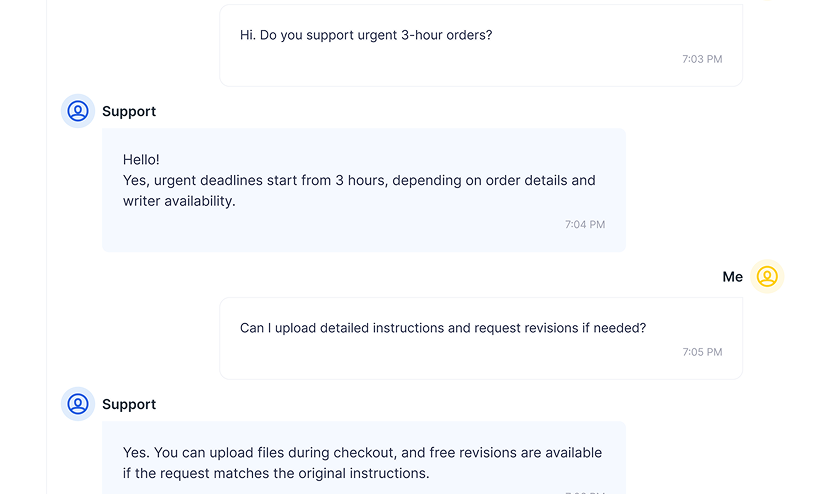
- The company states it can complete papers with a minimum 3-hour deadline.
- Rates can reach “$58 per page” for urgent tasks, framing deadline as the dominant price driver.
- The Plagiarism Free Guarantee page states a $9.99 add-on for a plagiarism report.
| Pricing Element | What WriteAnyPapers.com States | Implication for Predictability |
| Baseline per-page floor | Rates start from $10 per page; calculator examples show Total price 10 for a 14-day essay state. | Long deadlines are designed to anchor low price; good for planning. |
| Urgency ceiling signal | Rates can go up to $58 per page for urgent tasks; minimum deadline mentioned as 3 hours. | 3-hour work is expected to be the highest variance zone (price + quality variance). |
| Plagiarism check vs report | Checking is included, but a plagiarism report costs $9.99. | Transparency is decent: “check” vs “report” distinction is explicit. |
| “Your order includes” framing | Prices page lists included items (Title Page, Formatting, Revisions, Bibliography & Reference Pages) as “$ off” savings. | Marketing framing; still helpful as an inclusion checklist. |

What It Likely Does Well and Where It Can Mislead
WriteAnyPapers.com emphasizes support availability and policy-driven handling (refunds, revisions, plagiarism disputes). The system behavior is less “friendly chat” and more “policy gatekeeping,” which can be good (consistency) or frustrating (rigidity).
Representative Support Excerpts
The quotes below are reconstructed to reflect the platform’s documented policy logic.
“Free revisions are available up to 10 days from the final deadline in the system. If the revision request changes the original instructions, it may require an additional fee.”
“For urgent orders under 48 hours, a dispute can be opened only after at least one revision is completed.”
“If you’re requesting a plagiarism-based refund, please provide credible proof such as a Turnitin report with at least 10% matching.”
Revision Mechanics on WriteAnyPapers.com
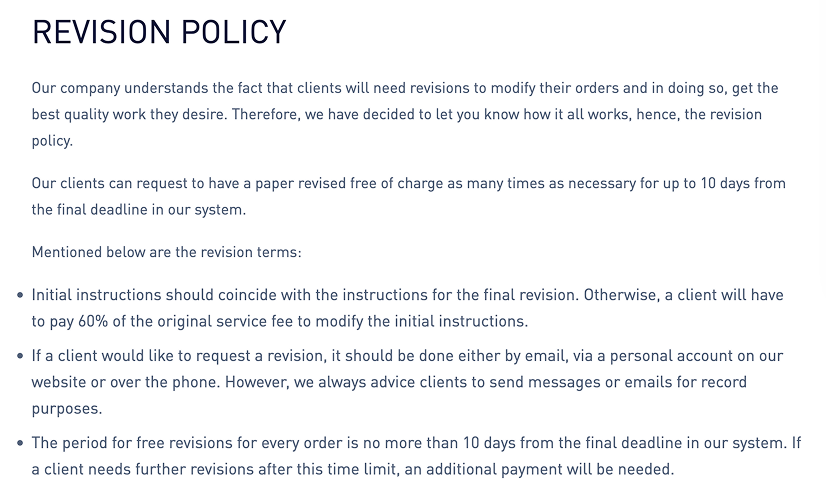
The revision policy is the clearest “system lever” on the site. The headline rule: free revisions as many times as necessary for up to 10 days from the final deadline in their system.
- If your final revision instructions do not “coincide” with the initial instructions, the policy states you may need to pay 60% of the original service fee to modify those instructions.
- For deadlines under 48 hours, a dispute can be opened only after finishing one revision.
- If you don’t specify a revision deadline, expect the revised paper not less than 24 hours after revision instructions are received.
Where It’s Strict and Why
WriteAnyPapers.com’s Money Back Guarantee is unusually specific about evidence standards and timing windows. The 100% refund cases include double payments, identical orders, and certain cancellation/payment errors — but timing matters (e.g., cancellation within 15 minutes of payment is explicitly mentioned as crucial).
- Plagiarism refunds are evidence-gated: they ask for “credible proofs” such as a Turnitin report and state a minimum matching percentage of 10%.
- Missed deadline is compensated by recalculation: if the initial version is delivered after the original deadline, the support team “recalculates the order price based on the actual delivery time.”

Transparency Index and Predictability Score
| Component | Score | Why I Scored It This Way |
| Revision window clarity | 8.7/10 | Clear 10-day free revision window and explicit constraints. |
| Refund evidence standards | 8.5/10 | Explicit proof requirements and examples (Turnitin, timing windows, late-delivery recalculation). |
| Plagiarism handling transparency | 8.2/10 | Distinguishes checking vs report; names the report price. |
| Pricing visibility (public) | 6.9/10 | Baseline/range signals exist, but full per-deadline matrix isn’t exposed in static view. |
| Order-flow explainability | 8.0/10 | How-it-works documentation maps to the UI logic and acknowledges tradeoffs. |
Transparency Index (overall): 8.1/10 — policy clarity is strong; pricing matrix transparency is the weakest link in publicly viewable pages.
Predictability Score: 7.8/10 — the largest variance driver is the “interpretation gap” between user instructions and writer execution, especially under 3-hour pressure. Policies can reduce variance, but they cannot eliminate it.
Surface Quality vs Structural Quality
| Deadline | Surface Quality (Expected) | Structural Quality (Expected) | Variance Risk | Best Use Case |
| 3 hours | Moderate to good | Moderate (thesis/logic shortcuts common) | High | Structure starter, outline + paragraph blocks, “get unstuck” materials |
| 48 hours | Good | Good if instructions are tight | Medium | Draft + revision cycle to align with rubric |
| 7 days | Good to strong | Good to strong (room for iteration) | Lower | Process support: research scaffolding, argument refinement, final polish |
Where It Can Fail
Failure Scenario 1: The “Instruction Drift” Trap
What happens: you request a revision that introduces new requirements (new sources, new stance, new formatting rules). Why it fails: policy states changes that don’t coincide with initial instructions may require 60% of the original fee. Mitigation: lock requirements up front; use revisions for alignment, not scope expansion.
Failure Scenario 2: The “3-Hour Structure Collapse”
What happens: you get a readable draft that lacks academic scaffolding. Mitigation: request an outline-first deliverable (even within urgent windows) and reserve time for a structural rewrite.
Failure Scenario 3: Refund Expectations vs Evidence Standards
What happens: the user expects “money back” based on dissatisfaction without documentation. Mitigation: treat refund as a formal dispute process; keep instruction records; gather objective evidence.
Who WriteAnyPapers.com Fits Best
If you look at WriteAnyPapers.com as a system, it is built around policy clarity + deadline flexibility + revision gating. That combination tends to produce a predictable user journey if you behave like a project manager: strong brief, clear acceptance criteria, and disciplined revision requests.
- Editing-first users: people who already have content but need formatting, coherence, and citation cleanup.
- Process support users: those who want outlines, structure models, and reference scaffolding.
- Planned-deadline users: those who can use the 7-day window to iterate and reduce variance.
Bottom line: WriteAnyPapers.com reads like a policy-driven platform with clear revision and refund mechanics, and a workflow designed for fast parameterized ordering. Its biggest predictability boost comes from tight instructions and longer deadlines; its biggest risk zone is the 3-hour window where structural quality is most likely to collapse even when surface quality looks fine.
FAQ
1) Will a “plagiarism-free guarantee” protect me from AI-detection issues?
No. Plagiarism and AI-detection are different categories. WriteAnyPapers.com discusses plagiarism checks and optional reports, but that does not equal “AI-proof.”
2) If I need to defend the argument in a viva or in-class discussion, what should I request?
Request a deliverable sequence: outline → annotated source list → draft. Then do a “defense pass” yourself.
3) What is the single best way to reduce revision drama?
Prevent “instruction drift.” Treat your first brief as your contract: define thesis, constraints, formatting version, and source requirements.
4) Is the 3-hour deadline realistically usable for anything beyond emergency triage?
It’s usable for triage: outline scaffolding, paragraph blocks, or a baseline draft you plan to rebuild. Urgency correlates with higher variance and higher pricing signals.
5) If I suspect plagiarism, what kind of proof does the system recognize?
The money-back policy emphasizes “credible proofs” such as Turnitin reports and references a minimum matching percentage threshold.