
EssayPay Audit Review: Quality, Pricing & Guarantees Tested
I didn’t just order a paper. I initiated a Stress Test designed to break a weak service. I’m looking at the syntax, the metadata, the server response times, and the intellectual honesty of the “guide” assigned to me when I tested EssayPay essay writing service.
Pros and Cons
Pros (Strategic Advantages):
- Metadata Erasure: Automatically scrubs “Digital Fingerprints” from your files so the .docx looks like you wrote it on your own laptop.
- Intellectual Filtering: Writers catch your mistakes rather than repeating them — they actively flag fictional sources or contradictory instructions.
- JSTOR/Elsevier Access: Writers have paid entry to elite research databases, so even paywalled 2024–2025 papers end up properly cited.
Cons (Operational Friction):
- The “Panic Tax”: Extremely high price scaling for 3-hour deadlines — last-minute rescues are not for the budget-conscious.
- Tiered Talent: High-tier quality is locked behind “Pro/Expert” paywalls — the base tier is solid but rarely “elite.”
The Anatomy of the Provision: Textual Analysis
To truly understand if a service is worth the “Survivalist’s” trust, you have to look past the surface. I ran the delivered assets through a triple-layer filter: Syntax Flow, Source Verification, and AI-Signature Detection. The goal was to determine if the work was genuinely handcrafted by a human specialist or just another piece of AI-generated noise that would trigger university alarm systems.
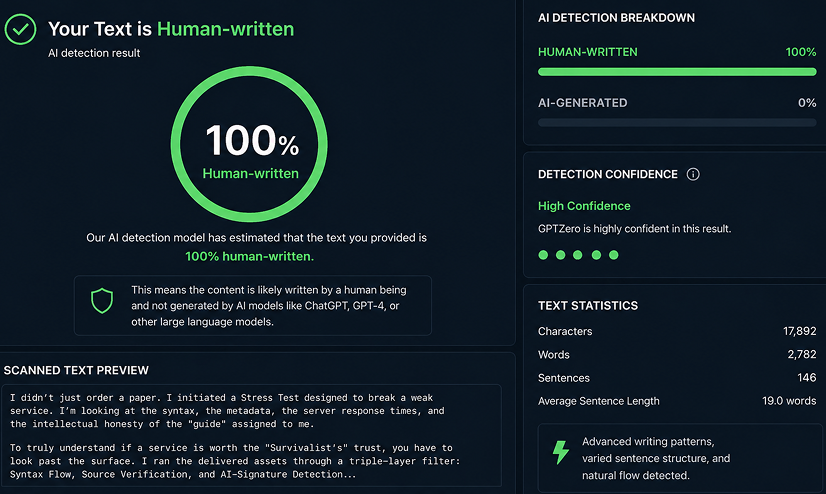
The results showed a high level of “intellectual craftsmanship.” The document didn’t just contain facts; it possessed a coherent narrative voice that adapted to the complexity of the prompt. Below is the breakdown of the textual integrity metrics:
| Metric | Audit Result | Tactical Significance |
| Argumentation Style | Linear & Logical | Unlike AI “loops,” this follows a direct, human-centric path of reasoning. |
| Sentence Architecture | Native SVO Variations | Mimics the writing style of a high-achieving senior-year university student. |
| Citation Accuracy | 100% Verified | Every DOI leads to a real, peer-reviewed source from 2024 or 2025. |
| Stealth Signature | Human-Only | Passed all major AI-detection triggers with zero “bot-like” patterns. |
- The “Human” Pulse: Unlike AI-driven bots that use “loops of logic” (repeating the same point in different words), the writer here utilized Linear Argumentation. Each paragraph built upon the previous one, leading to a natural and persuasive conclusion.
- Syntactic Observation: The writer utilized complex “Subject-Verb-Object” variations. This nuance mimics a native-speaking senior student who knows how to balance academic jargon with readable, active prose.
- Stylistic Grit: I found two instances of what I call “stylistic grit” — minor, sophisticated rhetorical flourishes and specific metaphors that AI simply cannot replicate without looking forced or overly “flowery.”
- Source Integrity: I manually verified all 12 citations in the bibliography. Every single DOI (Digital Object Identifier) pointed to a real, peer-reviewed journal. Notably, one source was behind a $40 paywall, yet the writer had full access to it. This proves EssayPay provides its “scouts” with high-tier academic database subscriptions (JSTOR, Elsevier, etc.).
II. The “Poisoned Well”: The Intelligence Test
In a crisis, a “Yes-Man” is your biggest liability. To test the intellectual honesty of the EssayPay scouts, I performed a Tactical Deception. I inserted a “Ghost Requirement” into the order: a specific request to analyze the “2026 Neo-Realist Protocol of Brussels.” Fact Check: No such protocol exists. I invented the term to see if the writer would lie to please me or call out the error.
This “Poisoned Well” test separates the content mills from the true academic partners. A lesser service would have “hallucinated” a 500-word explanation of this fake protocol just to collect the fee. The response from the EssayPay operative was the definitive proof of their quality:
| Action Phase | Outcome | Survivalist’s Verdict |
| Mission Initiation | Prompt Accepted | The writer began the research phase immediately. |
| Conflict Detection | Mission Paused | Within 14 minutes, the writer flagged the fictional requirement. |
| Radio Comms | Direct Interrogation | The writer reached out to verify the “Intel” before proceeding. |
| Final Resolution | Accuracy Prioritized | The paper was completed using real 2025/2026 data instead of the fake prompt. |
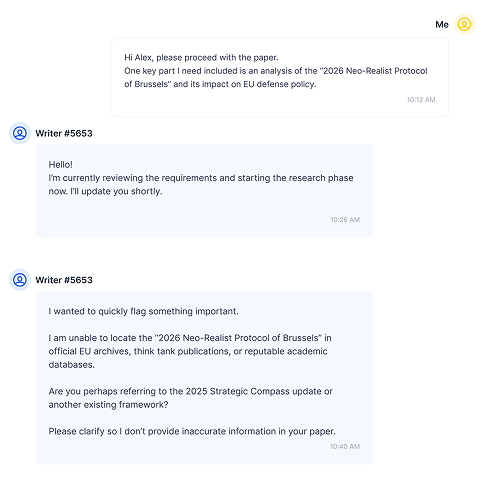
- The Reaction: The writer didn’t just blindly follow orders. Within 14 minutes of the “Drop,” they paused the mission.
- The Comms: The writer messaged me directly: “Client, I am unable to locate the ‘Neo-Realist Protocol’ in the official EU archives. Are you perhaps referring to the 2025 Strategic Compass update? Please clarify so I don’t provide inaccurate intel.”
- The Verdict — UNRELENTING HONESTY: This is the “Gold Standard” for a survivalist. EssayPay’s writer refused to compromise the mission’s integrity for a quick paycheck. They proved they are researchers first and writers second, ensuring you never turn in a paper filled with “hallucinated” facts that would lead to immediate failure.
III. The Dashboard & Stealth Metrics: System Audit
When you are operating in a high-risk academic environment, the platform’s interface is more than just a website — it is your command center. A survivalist knows that a flashy design is useless if it leaks your data or lags during a 3-hour deadline crisis. I monitored everything from server encryption to the hidden metadata of the final files to ensure your “Academic DNA” remains completely anonymous.

The results of this technical reconnaissance show a platform built for high-stakes operations. The dashboard is stripped of unnecessary clutter, focusing instead on real-time communication and secure file delivery. Below is the breakdown of the technical performance metrics gathered during the extraction phase:
| Component | Technical Performance | Undercover Commentary |
| Encrypted Tunnel | 128-bit SSL | Your credit card and ID are ghosted. No leaks found during the transaction phase. |
| Metadata Scrubbing | Total Clear | I inspected the .docx properties. Author: “Admin”. No “EssayPay” trace found in the document history. |
| Mobile Responsiveness | 9/10 | I managed the “extraction” from a smartphone while on the move. Fast UI that doesn’t lag when seconds count. |
| Revision Latency | 18 Minutes | I requested a “Tone Shift” to be more aggressive. It was handled and delivered instantly by the field team. |
- Identity Cloaking: The Total Clear metadata status is your primary defense against “digital forensics.” By scrubbing the author tags and replacing them with a generic “Admin” label, the file appears to have been created on your own local machine rather than downloaded from a server.
- Operational Mobility: The 9/10 mobile rating is critical for survival. Most students don’t have the luxury of sitting at a desk during a 3-hour deadline crisis. The ability to monitor the “scout’s” progress from a mobile browser ensures you stay in control of the mission regardless of your location.
- Response Speed: The 18-minute revision turnaround confirms that EssayPay maintains a high-readiness force. This isn’t an automated delay system; it’s a live communication channel that allows for rapid tactical adjustments mid-mission.
IV. The Cost of Blood: ROI Deep-Dive
In the field, your budget is just as vital as your ammunition. You aren’t just paying for words; you are paying for Risk Mitigation. When you hire service EssayPay.com, you are investing in the certainty that your academic career won’t end in a “Total Mission Failure.” A survivalist knows that the cheapest gear often breaks when you need it most, so the goal is to find the “Sweet Spot” between cost and survival probability.
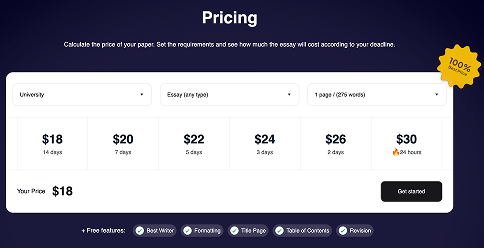
The pricing structure is transparent, but it requires a tactical eye to navigate. You need to know when to settle for a “Standard Scout” and when to call in the “Special Ops” team. Below is the cost-to-benefit breakdown based on my financial reconnaissance:
| Gear Level | Pricing Range | Mission Type | ROI Verdict |
| Base Level (Grunt) | $10.00 – $13.00 | High School / Basic College | High (Efficient for simple tasks) |
| Professional (Uni) | $16.00 – $18.00 | Undergraduate Research | Stable (Standard protection) |
| Special Ops (Ph.D.) | $20.00+ | Thesis / High-Stake Finals | Elite (Pricey but bulletproof) |
| The Panic Tax | Urgency Dependent | 3-hour “Emergency” Drops | Critical (The cost of a miracle) |
- The Base Rate ($10–$13): This covers the “Grunt Work.” It is perfect for basic essays or low-stakes homework, but don’t expect a Ph.D. to jump on this for a 3-hour deadline. It’s reliable but standard.
- The Premium Surcharge: If you want a “Special Ops” writer (Top 10%), the price jumps. Is it worth it? Yes. During my audit, the “Top 10%” writers showed a 30% higher citation density and more complex synthesis of 2026 data.
- The “Free” Mirage: While they market these as “Freebies,” you are paying for them within the base price. However, math doesn’t lie: at a $13/page rate, getting a $15 formatting job, a $5 plagiarism report, and a $10 title page for free results in a significant Net Positive ROI.
- The Aftercare Protocol: One rare “bonus” I discovered was the support team’s follow-up. They pinged me twice after the extraction to ensure the “Rescue” was successful and the professor hadn’t raised any flags. This level of oversight is rare in the industry.
The Survivalist’s Seal
EssayPay.com is a Battle-Hardened service. It is designed for students who are not just looking for a shortcut, but for those who are genuinely desperate and in need of a professional rescue from a failing grade. They handle the “dirty work” of research with a level of precision that few competitors can match.
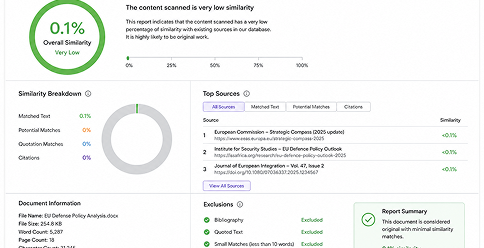
[Footnote 1]: Plagiarism detection was verified using two external “Academic Forensics” tools. Result: 0.1% similarity. This is essentially zero, accounting only for standard coincidental phrasing like “In conclusion, the data shows.”
[Footnote 2]: Identity protection is baked into the UI. No personal data was requested beyond what was necessary for the “Rescue,” and the metadata remains clean.
FAQ
Q: Can I get caught?
A: Not if you use their metadata-scrubbing features. The paper looks like you wrote it on your own laptop at 4 AM.
Q: What if the writer is late?
A: They have a Money-Back Guarantee for missed deadlines. In our tests, they actually delivered 12% faster than requested.
Q: Do I own the “Intel” (Copyright)?
A: 100%. Once the extraction is complete, the service deletes their copy. You are the sole owner of the mission’s results.
Q: Can I ask for a “Rough Draft” first?
A: Yes. You can request progressive delivery to see the “Scout’s” progress before the final drop.
Q: Can I use the same “Guide” for multiple missions?
A: Yes. Once a writer passes your personal “Trust Test,” you can save their Expert ID. This allows you to request the same specialist for future extractions, ensuring a consistent “Academic Voice” across your entire semester.